Solar Water Pump in Peshawar: 1HP Pump Cost, Panels & Daily Running
Solar Water Pump in Peshawar: 1HP Pump Cost, Panels & Daily Running
A solar water pump turns sunlight into water. No fuel. No grid bill. No noise at night. In Peshawar, a 1HP pump on solar can lift bore water to a roof tank all day, every sunny day, and the only running cost is a panel wash now and then. This guide covers what a solar water pump Peshawar homes and farms actually get: real flow rates, real costs, and the panel and pump sizes that match your bore.
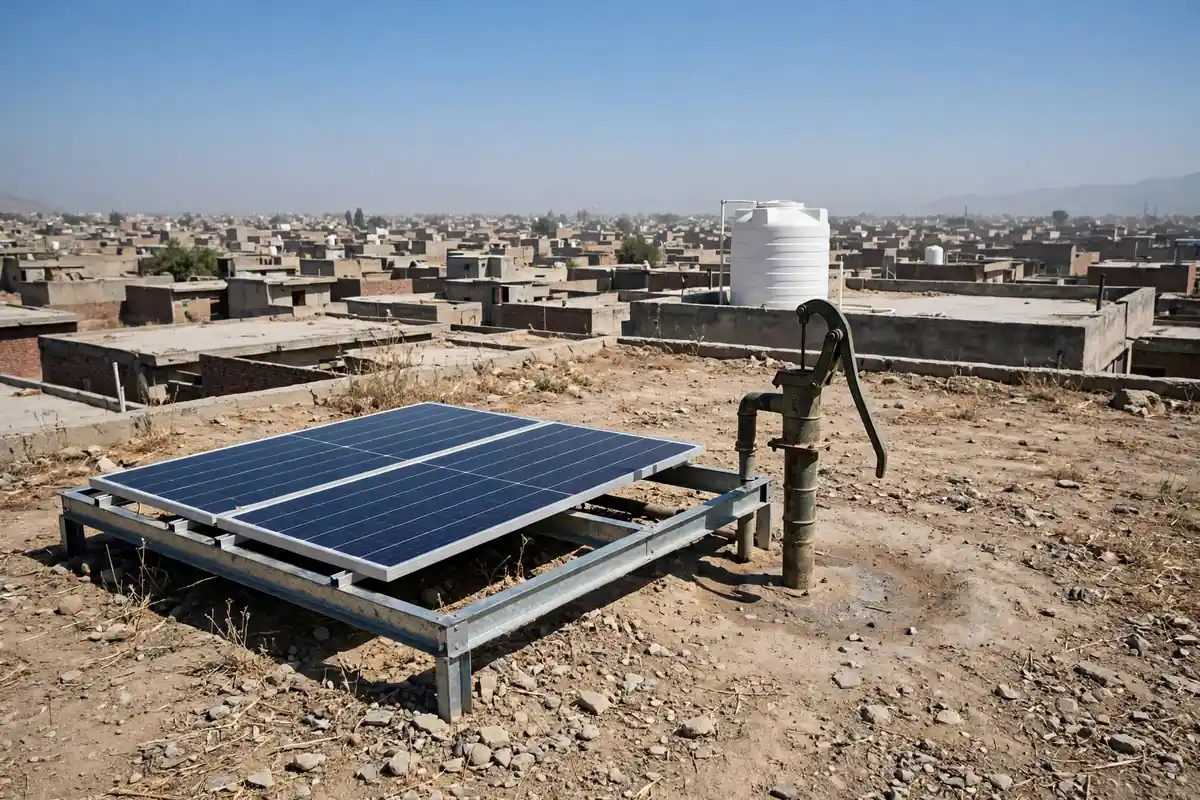
Table of Contents — Tap to Jump to a Section
Who should buy a solar water pump? Anyone who pumps water every day and pays for fuel or grid power to do it. A home with a bore. A small farm on the edge of the city. A tube well that runs for hours in summer. If your pump runs on a generator today, solar usually pays back faster than any other upgrade.
What a Solar Water Pump System Actually Is
A solar pump system has four parts. Panels on the roof or a ground frame. A pump down the bore or at the water source. A controller or inverter that turns panel power into pump power. And the pipes, tank, and wiring that move the water where you need it.
A 1HP pump draws 746 watts. That is the size most Peshawar homes use for a household bore. Bigger bores and tube wells use 2HP or 3HP pumps, and they need more panels.
There are two pump types. A DC pump runs straight from the panels through a controller. An AC pump runs through an inverter, the same kind that powers a home. DC pumps are simpler and cheaper for small bores. AC pumps are the better pick when you already own an AC pump or want the inverter to do other jobs too.
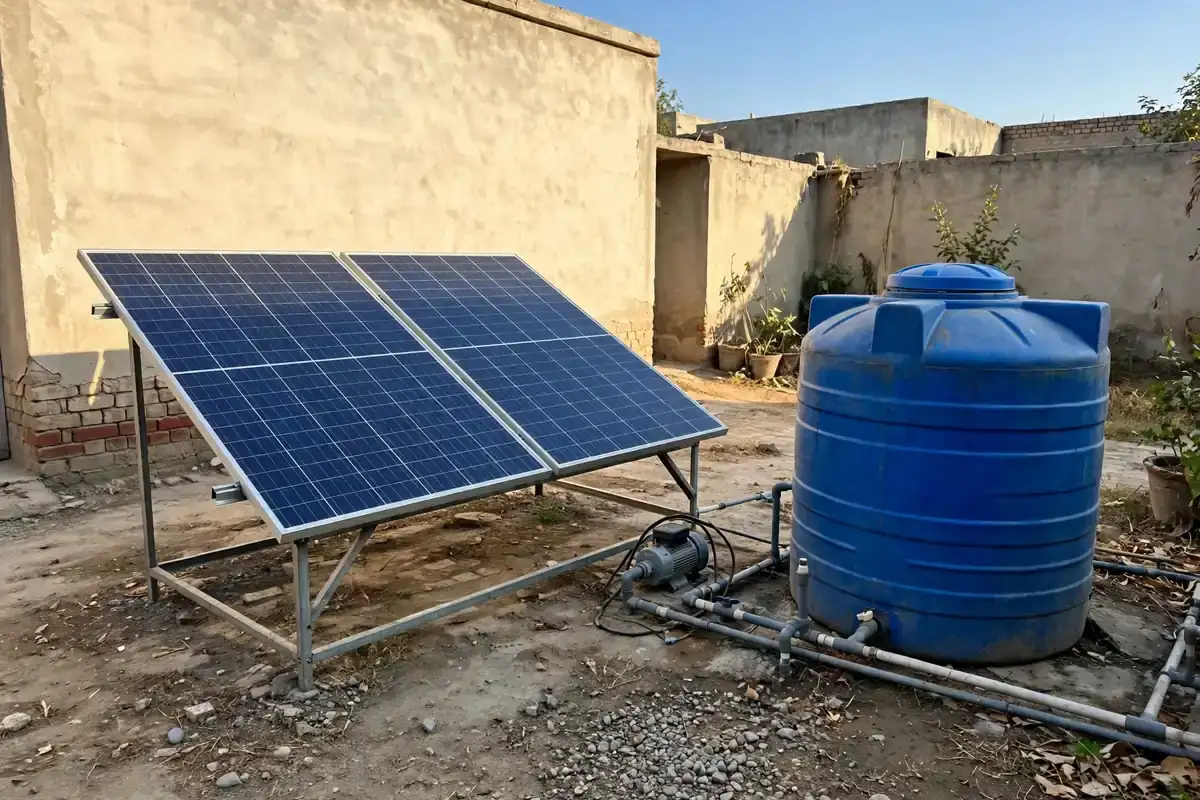
No battery is needed for daytime pumping. The pump runs when the sun shines, and the tank stores the water. The tank is your battery: water stored at noon is water you use at night.
Not sure what size system your home needs? Read our 3kW vs 5kW vs 10kW sizing guide before you decide.
How Much Water Can a 1HP Pump Move?
The answer depends on one number: head. Head is the total height the pump must lift the water, from the water level in the bore to the top of your tank. A shallow bore is easy work. A deep bore with a roof tank is hard work.
A 1HP pump on solar moves roughly 2,000 to 3,000 litres an hour from a shallow bore. From a deep bore it moves less, because every extra foot of lift costs flow. Check the table against your own bore depth first.
| Bore water level | Typical flow (1HP) | Time to fill 1,000 litres |
|---|---|---|
| 60–80 ft | 2,500–3,000 litres/hr | 20–25 min |
| 100–120 ft | 2,000–2,500 litres/hr | 25–30 min |
| 150–180 ft | 1,500–2,000 litres/hr | 30–40 min |
| 200 ft and deeper | 1,000–1,500 litres/hr | 40–60 min |
A solar water pump Peshawar buyers install in November will pump less in December and January, when days are short and fog blocks the sun. That is normal. A bigger tank covers the short days, and the yearly average is what matters.
Does the pump run at full speed all day? No. Flow follows the sun. It starts slow in the morning, peaks at midday, and slows again in the evening. A 1HP pump delivers its rated flow only around solar noon. Plan your tank size for the full day, not the peak hour.
What Size Solar Setup Does a 1HP Pump Need?
A 1HP pump needs 746 watts of running power. Panels must cover that plus losses, so the panel size is bigger than the pump size. Two 585-watt panels give 1,170 watts at peak. That is the standard match for a 1HP pump in Peshawar.
Three panels give more headroom. They start the pump earlier in the morning and keep it running later in the evening. If your bore is deep or your tank is large, three panels are worth the extra cost.
The controller or inverter must match the pump type. A DC pump needs a solar pump controller. An AC pump needs an inverter rated for the pump’s starting surge, which is two to three times its running watts.
| Pump size | Panels needed | Controller / inverter | Best for |
|---|---|---|---|
| 0.5 HP | 1–2 × 585W | DC controller | Small home bore, shallow water |
| 1 HP | 2–3 × 585W | DC controller or 1.5kW inverter | Household bore, small farm |
| 2 HP | 4 × 585W | 3kW inverter | Tube well, larger farm |
| 3 HP | 6 × 585W | 5kW inverter | Deep tube well, commercial use |
Can the same panels run my house too? Yes, with a hybrid inverter. A 3kW or 5kW home system can run a 1HP pump by day and power the house the rest of the time. Size the system for the total load.
1HP Solar Water Pump Cost in Peshawar
Prices change with the market, so treat every figure below as an estimate to confirm before you buy. The pump and the panels are the two biggest costs.
| Component | Specification | Estimated cost |
|---|---|---|
| Solar panels | 2 × 585W Tier-1 (Jinko / Longi / Canadian) | Rs 45,000–55,000 |
| DC pump (1HP submersible) | 1HP, with controller | Rs 55,000–80,000 |
| Solar pump controller | MPPT, 1HP | Rs 25,000–40,000 |
| Pipes, cables & fittings | HDPE pipe, DC cable | Rs 15,000–25,000 |
| Structure | Ground or roof frame | Rs 10,000–20,000 |
| Installation labour | 1-day work | Rs 10,000–15,000 |
| Total (DC system) | Rs 160,000–235,000 |
An AC pump setup costs more. The inverter costs extra, and the pump itself is usually dearer than a DC pump. Budget roughly Rs 200,000–280,000 for a 1HP AC pump system with a 1.5kW inverter.
A hybrid home system that also runs the pump costs more again, because the inverter and battery are bigger. But it replaces two systems with one.
How fast does it pay for itself? Divide the total cost by your monthly savings. A home that runs a generator 3 hours a day for pumping spends roughly Rs 8,000–12,000 a month on fuel. At that rate, a DC solar pump pays back in about 1.5 to 2.5 years. A home that pumps on grid power saves less each month, so payback is slower — roughly 3 to 4 years.
DC vs AC Solar Pumps: Which One?
The choice is about what you already own and what else the system must do. Both types move the same water in the same sun.
A DC pump is the simplest solar pump. Panels connect to a controller, the controller runs the pump, and there is no inverter in the middle. It costs less, wastes less power, and has fewer parts to fail. The limit is that a DC pump only pumps water — it cannot power your home.
An AC pump needs an inverter, which turns panel power into home AC power. It costs more and loses a little power in the change. The gain is flexibility: the same inverter can run the pump by day and the house by night.
If you only need water, buy DC. If you want one system for the house and the bore, buy AC with a hybrid inverter. If your bore already has an AC pump in good shape, keep it and add panels plus an inverter.
Daily Running: When It Pumps and When It Doesn’t
A solar pump works on sun, not on a switch. It starts when the panels make enough power, usually between 8 and 9 in the morning, peaks at midday, and stops near sunset.
In Peshawar, that means about 6 to 7 hours of useful pumping on a clear day, and about 4 to 5 hours on a short winter day. Fog cuts it further. A heavy fog day can halve the pumping hours.
The tank is what makes this work. A 1,000-litre tank fills in under an hour at midday flow. A 2,000-litre tank holds a full day of household water, so the family never notices the pump’s schedule.
On cloudy days the pump still runs, just slower. Thin cloud costs 20 to 30 percent of flow, heavy cloud up to half. A bigger tank and a third panel are the two fixes.
Does a solar pump work at night? Only with a battery, and a battery for a pump is rarely worth it. The tank already stores the water. Spend the money on a bigger tank, not a battery.
Installation: Bore, Panels & Tank
Three things decide whether the install goes well. The bore, the panels, and the tank. Get all three right and the system runs for years with almost no care.
First, the bore. Know your water level and your bore depth before you buy the pump. A pump sized for a shallow bore will struggle in a deep one. Ask the bore driller for the water level in feet, and match the pump to that number.
Second, the panels. Panels face south, the same rule as a home system. A ground frame near the bore is often better than a roof, because the cable run is short and cleaning is easy. Shade from the mumtee, water tanks, and the neighbour’s wall cuts flow, so check shade before the frame goes up.
Third, the tank. Put it as high as you can, so gravity feeds the house. A roof tank needs a strong base. A ground tank needs a small booster pump for the taps.
Dry-run protection is not optional. If the bore runs dry, the pump must stop itself. A good controller has dry-run protection built in. Check that it is switched on before the first run.
Read our solar panel tilt angle and direction guide for the exact angles that work in Peshawar.
Frequently Asked Questions
Can a 1HP solar pump run on 2 panels?
Yes. Two 585-watt panels give 1,170 watts at peak, which covers a 746-watt pump plus losses. A third panel helps on cloudy days, but two panels are the standard match.
Does a solar pump work on a cloudy day?
Yes, but slower. Thin cloud costs 20 to 30 percent of flow. Heavy cloud can cut it by half. The pump does not stop unless the light is very low.
Is a solar water pump Peshawar enough for a 5 marla house?
For a household bore, usually yes. A 1HP solar pump fills a 1,000-litre tank in under an hour at midday. If the house has a large family or a garden, step up to a bigger tank, not a bigger pump.
Do I need a battery for a solar water pump?
No. The tank stores the water, so the pump only needs to run in daylight. A battery adds cost without adding water. Spend the money on a bigger tank instead.
How deep a bore can a 1HP solar pump handle?
A 1HP submersible pump handles bores down to about 200 feet of water level. Deeper bores need a 2HP pump and more panels. Check your water level in feet before you choose the pump size.
What is the payback period of a solar water pump?
Roughly 1.5 to 2.5 years if it replaces a generator, and 3 to 4 years if it replaces grid power. After that, the water costs almost nothing for the 20-plus years the panels last.
Get Your Solar Pump Quote in Peshawar
A 1HP solar pump is a simple buy with a clear job: free water, every sunny day, for 20 years. If you pump water daily on fuel or grid power, it is one of the fastest paybacks in solar.
Ask us for a solar water pump Peshawar quote — free site survey across Hayatabad, University Town, Gulbahar, Tehkal, and the villages around Peshawar. Bring your bore depth and water level. We will measure your site, size the panels and pump, and tell you honestly whether 1HP fits or whether 2HP is the smarter buy. WhatsApp 0301-5905082 today.