December Solar Output in Peshawar: What Your System Will Actually Produce
December Solar Output in Peshawar: What Your System Will Actually Produce
December is the weakest solar month in Peshawar. Short days, low sun, and morning fog all cut into what your panels make. This guide gives you the real solar output December Peshawar homeowners can expect — month-specific numbers, not guesses. You will see output by system size, what fog really costs you, and what December does to your PESCO bill.
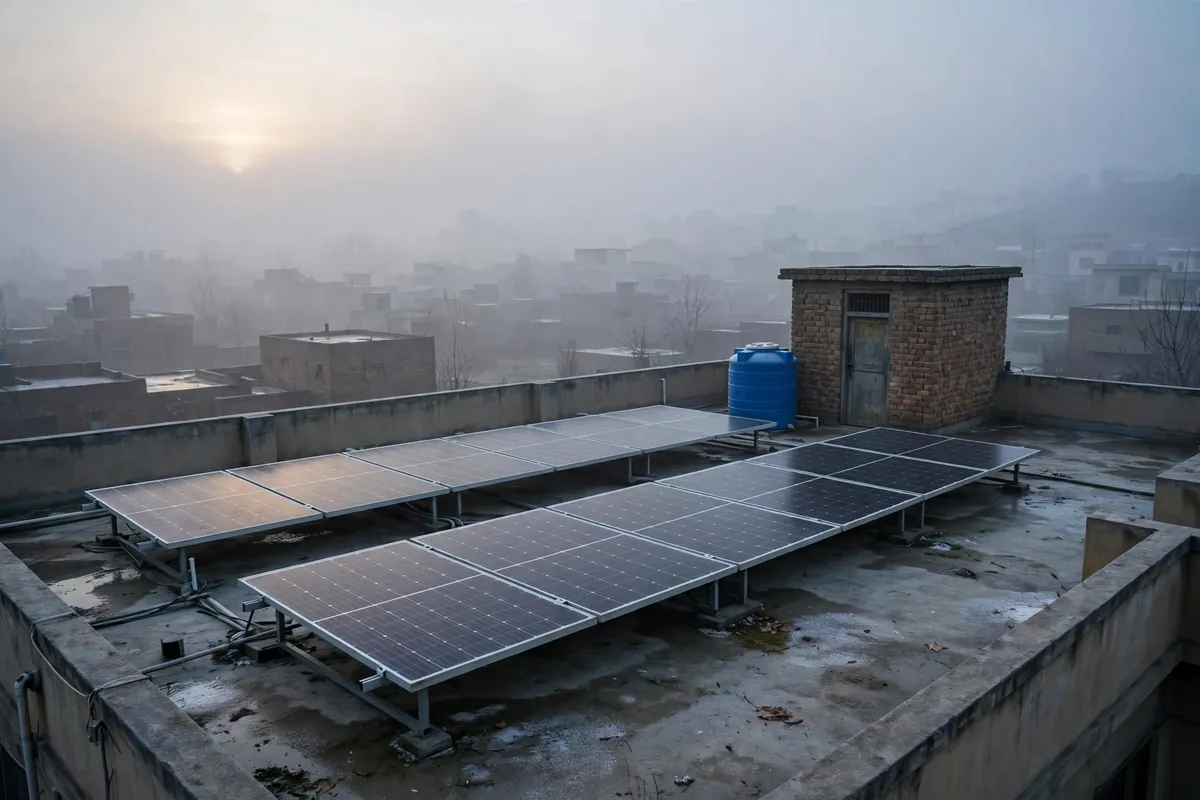
Table of Contents — Tap to Jump to a Section
Who should read this guide? Anyone who already has solar and wonders why December units dropped. Anyone planning a new system who wants honest winter numbers. And anyone comparing quotes who was only shown summer output.
Why December Output Drops
December has the shortest days of the year. The sun rises late and sets early, so your panels get about 10 hours of daylight. The sun also stays low in the sky. Its light hits your panels at a slant, and slanted light makes fewer units than direct midday sun.
Fog is the second cause. Cold December nights cool the air close to the ground. Moisture in that air turns into fog by morning. Many December mornings in Peshawar start foggy, and panels make little power until the fog lifts.
Smog adds a third layer. Winter air traps dust and smoke close to the ground. The haze dims the sun even after the fog clears. A clear-looking December noon can still be hazier than a summer noon.
Cold mornings also leave dew on the panels. Dew mixes with dust and dries into a thin grey film. That film blocks light until the panel is cleaned. It is a small loss on its own, but it adds up across a foggy month.
None of this means your system is broken. December is the floor of the year, not the average. A system that meets your needs in December will meet them all year. Judge a new system after a full year, not after its first foggy month.
December Output by System Size
The table below shows the solar output December Peshawar systems of different sizes produce on clear and foggy days. A clear December day gives about 3.0 to 3.5 units per kW. A dense fog day can cut that by half or more.
| System size | Clear December day | Dense fog day | December month total |
|---|---|---|---|
| 1kW | 3.0–3.5 units | 1.0–1.7 units | 75–90 units |
| 3kW | 9–10.5 units | 3–5 units | 225–270 units |
| 5kW | 15–17.5 units | 5–8.5 units | 375–450 units |
| 10kW | 30–35 units | 10–17 units | 750–900 units |
Read the month total as a range, not a promise. A December with more foggy mornings lands near the low end. A clear, sunny December lands near the high end. Your own monitoring app shows the real number for your roof.
The gap between sizes is simple math. A 5kW system makes five times what a 1kW system makes on the same day. Fog cuts both by the same percentage. So a bigger system still helps in December — it just helps from a lower starting point.
Do panels produce anything at all on a foggy day? Yes. Light still reaches the panel through fog, just less of it. Even on the worst fog day, a 5kW system usually makes 5 to 8 units. That covers fans, lights, and a TV for the day.
December vs the Rest of the Year
December sits at the bottom of the year. The table below shows approximate units per kW per day for each month in Peshawar. Treat these as estimates — your roof angle, shade, and cleaning schedule shift the real numbers.
| Month | Units per kW per day |
|---|---|
| January | 3.0 |
| February | 3.8 |
| March | 4.5 |
| April | 5.0 |
| May | 5.3 |
| June | 5.2 |
| July | 4.6 |
| August | 4.4 |
| September | 4.7 |
| October | 4.3 |
| November | 3.7 |
| December | 3.2 |
The gap between December and May is large. A 5kW system makes about 16 units on a clear December day and about 26 units on a clear May day. That gap is why sellers quote summer numbers — they look better. Always ask for the December number before you sign.
One more point. December output is low, but December bills are high. Heaters and geysers run more in winter. So the month with the least solar is also the month you need power most. That is the honest math of winter solar.
If your December bill stays high every year, your system may be too small. Read our 3kW vs 5kW vs 10kW sizing guide before you add panels.
Fog Days: What Actually Happens
Fog does not stop your panels. It dims them. Light still reaches the panel through fog, just less of it. The loss depends on how thick the fog is and how long it lasts.
| December condition | Daily output loss | What helps |
|---|---|---|
| Dense fog, all morning | 50–70% | Nothing to do — wait for the sun |
| Thin fog or haze | 20–30% | Cleaning helps a little |
| Dew + dust film on glass | 10–20% | Clean every 10–15 days |
| Shade from low winter sun | Varies | Check shade at 10 am and 2 pm |
| Short December days | Fixed | Nothing to do — days lengthen from January |
Fog usually lifts by late morning. Panels make most of their December power between 11 in the morning and 3 in the afternoon. A foggy 8 am costs little. A foggy noon costs a lot.
Dew makes fog worse. Overnight dew settles on the glass. Dust sticks to the wet glass. By morning the panel carries a thin grey film. That film alone can cut output by 10 to 20 percent until the panel is cleaned.
December typically brings many foggy mornings in Peshawar. Count on at least a third of the month starting foggy. Plan your expectations around that, not around clear-sky brochures.
Panel angle matters more in winter. Low sun needs a steeper tilt to hit the glass straight on. Read our solar panel tilt angle and direction guide for the angles that catch low winter sun.
What December Means for Your PESCO Bill
Lower output means you buy more units from PESCO. A home that uses 300 units in December and makes 150 from solar still buys 150 units. At the 201–300 unit slab, those units cost about Rs 33.10 each.
Winter loads make it worse. Electric geysers and room heaters draw heavy power. A geyser alone can use 6 to 8 units a day. That is more than a 1kW system makes on a foggy December day.
Check your December bill against your November bill. If the bill jumped, look at two things: your solar units for the month, and your geyser and heater use. Most December bill shocks come from heaters, not from broken panels.
Net billing helps a little in December. Export is low because the system makes less and the home uses more. Do not count on export income in December. Count on it from March to October, when output is high and the home uses less.
Why does my bill rise in December even with solar panels? Because two things move against you at once. Output falls to its lowest point of the year, and winter loads push your use up. Solar still cuts the bill — just less than it does in summer.
How to Protect Your December Output
Cleaning is the biggest lever. In fog season, clean your panels every 10 to 15 days. A clean panel in fog makes far more than a dusty one. Use plain water and a soft cloth. Do it in the late morning, after the dew dries.
Check your tilt. Winter sun sits low. A steeper tilt catches more of it. If your structure allows a winter angle, set it in November and change it back in March. A fixed tilt is fine too — just know it costs a little winter output.
Watch for shade. Winter sun comes from a lower angle, so shadows stretch longer. A wall or mumtee that never shaded your panels in June can shade them in December. Check the roof at 10 in the morning and again at 2 in the afternoon.
Watch your monitoring app. A sudden drop that cleaning does not fix means something else — a tripped breaker, a loose connection, or an inverter fault. Call your installer instead of waiting for spring.
Use plain water at normal temperature. Never use harsh chemicals or a hard brush. They scratch the glass, and the damage is permanent. A soft cloth and clean water are enough.
Is December a Bad Month to Install Solar?
No. December is a good month to install, for three reasons.
First, installers are free. The spring rush has not started. Your job gets done in days, not weeks. You also get more time with the installer to ask questions.
Second, you see the worst month first. If your system covers your needs in December, it will cover them all year. No surprises in January, and no disappointment when the fog rolls in.
Third, prices are usually steady in winter. Panel rates move with the dollar and the market, but December rarely brings the spring price jumps.
The only honest warning is about expectations. Do not judge a new system by its first December. Judge it after a full year. December is the floor, and the floor is not the whole story.
Book a free site survey and we will size your system from your actual bills and your roof.

Frequently Asked Questions
How many units will a 5kW system produce in December in Peshawar?
About 375 to 450 units for the month, or 15 to 17 units on a clear day and 5 to 8 units on a dense fog day. That is the solar output December Peshawar homeowners should use when they size a system for winter.
Does solar work on a foggy December day in Peshawar?
Yes, but less. Dense fog can cut output by 50 to 70 percent for that day. Thin fog costs 20 to 30 percent. The panels still make power — just fewer units.
Is December the worst month for solar output in Peshawar?
Yes, along with January. December has the shortest days and the most fog. Output rises again from February as days lengthen.
Should I clean my panels more often in December?
Yes. Clean every 10 to 15 days in fog season. Dew and dust form a film that cuts output by 10 to 20 percent until you clean it.
Will my December PESCO bill go up even with solar panels?
It can. December output is low and winter loads are high — geysers and heaters use more power. Solar still cuts the bill, just less than in summer.
Is it worth installing solar panels in December?
Yes. Installers are free, and you see the weakest month first. A system that works for you in December will work all year.
Get Your December Solar Estimate in Peshawar
December numbers are the honest numbers. If a quote only shows you summer output, ask for the December figure before you decide.
Ask us for a solar output December Peshawar estimate for your own roof — free site survey across Hayatabad, DHA Peshawar, University Town, Gulbahar, and Tehkal. Bring your last three PESCO bills. We will measure your roof, check your sanctioned load, and tell you what your system will really make in December. WhatsApp 0301-5905082 today.