Solar Inverter Prices in Peshawar 2026: Which One Should You Buy?
Solar Inverter Prices in Peshawar 2026: Which One Should You Buy?
The inverter is the brain of your solar system. It converts DC power from your panels into AC power your home uses. It also decides whether you get backup during load shedding. This guide covers solar inverter prices in Peshawar for 2026, the three inverter types, and how to choose the right one.
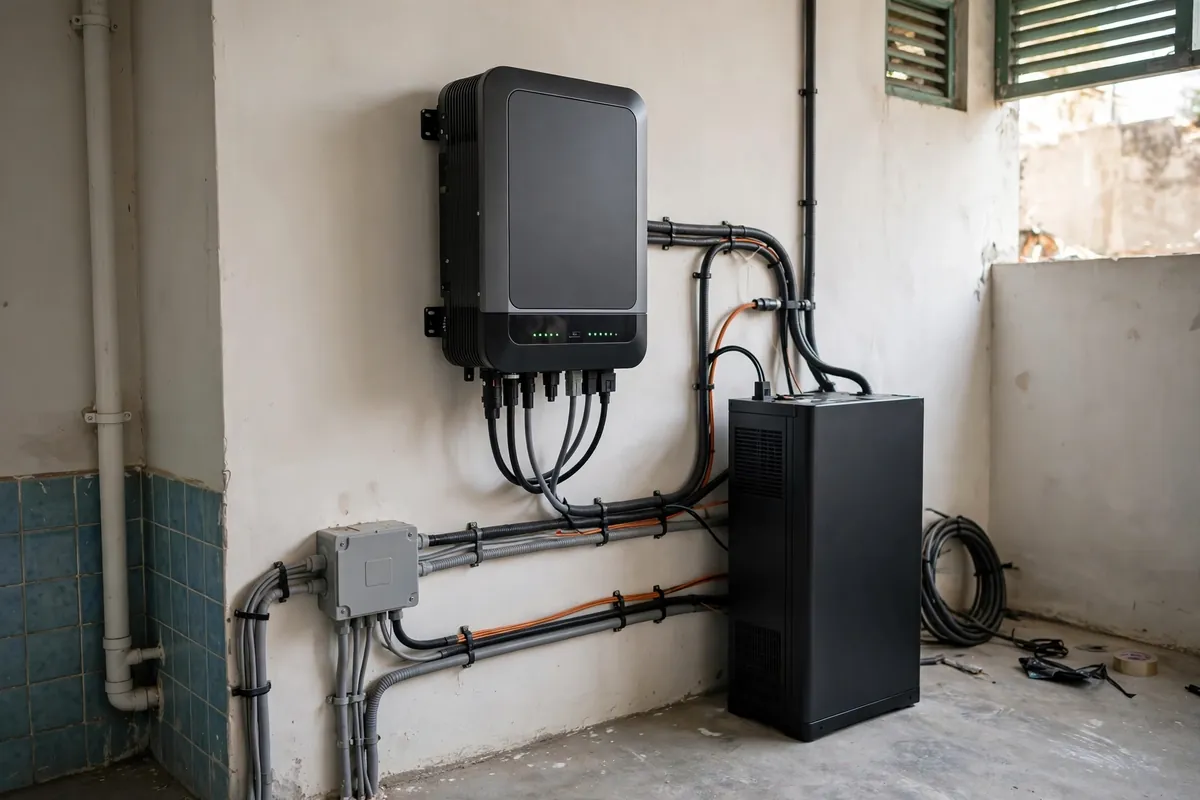
Table of Contents — Tap to Jump to a Section
- 01Why the Inverter Matters More Than Most…
- 02The Three Types of Solar Inverters
- 03Solar Inverter Price in Peshawar: 2026…
- 04Popular Inverter Models in the Peshawar…
- 05How to Size Your Inverter to Your System
- 06Six Features That Actually Matter
- 07Six Mistakes Peshawar Buyers Make
- 08Matching Inverters to Common Peshawar…
- 09FAQs
Why the Inverter Matters More Than Most Buyers Think
Panels get all the attention. The inverter does the real work. It runs all day in 45°C Peshawar heat and handles PESCO voltage swings. A cheap inverter fails early and takes your savings with it.
Most buyers spend weeks comparing panel brands. Then they let the installer pick the cheapest inverter. That is backwards. Your inverter will be the first part you replace. Choose it well.
The Three Types of Solar Inverters
Every inverter sold at Karkhano market falls into one of three categories. Your choice here shapes everything: your bill savings, your backup power, and your total cost.
On-Grid (Grid-Tie) Inverters
An on-grid inverter connects your panels directly to the PESCO grid. It feeds solar power to your home and exports the surplus under net billing. It costs the least but shuts down completely during load shedding — a safety rule, not a defect. It suits areas with stable power: parts of DHA Peshawar, Hayatabad, and University Town.
Hybrid Inverters
A hybrid inverter manages solar panels, batteries, and the PESCO grid together. It keeps fans, lights, and the fridge running through load shedding while still exporting surplus under net billing. It costs more because of the battery management hardware. For most Peshawar homes in 2026, this is the default recommendation — Gulbahar, Tehkal, Saddar, and Warsak Road still see regular outages.
Off-Grid Inverters
An off-grid inverter runs on solar and batteries with no PESCO connection. It needs a very large battery bank and suits farmhouses or remote sites with no reliable grid. Most Peshawar city homes do not need this — you pay far more and lose export income.
| Feature | On-Grid | Hybrid | Off-Grid |
|---|---|---|---|
| Battery required | No | Yes (for backup) | Yes (large bank) |
| Works during load shedding | No | Yes | Yes |
| Net billing export | Yes | Yes | No |
| Price level | Lowest | Medium–High | Highest |
| Best for | Stable-grid areas | Most Peshawar homes | Farmhouses, tubewells |
Can a hybrid inverter work without batteries? Yes, it can. It then behaves like an on-grid inverter. You simply pay extra for hardware you are not using. Buy the battery later only if you plan to add it.
Solar Inverter Price in Peshawar: 2026 Ranges
Prices move with the dollar rate and Karkhano stock. Ranges below are indicative 2026 dealer figures — confirm before buying.
| Inverter Capacity | On-Grid Price Range (Rs) | Hybrid Price Range (Rs) |
|---|---|---|
| 3 kW | 80,000 – 130,000 | 95,000 – 200,000 |
| 5 kW | 120,000 – 170,000 | 130,000 – 350,000 |
| 6 kW | 140,000 – 200,000 | 155,000 – 380,000 |
| 8 kW | 180,000 – 250,000 | 220,000 – 420,000 |
| 10 kW | 220,000 – 350,000 | 300,000 – 500,000 |
| 12 kW and above | 280,000+ | 400,000 – 600,000+ |
Notice the pattern. Hybrid inverters cost roughly 40–60% more than on-grid units at the same capacity. The difference buys you load-shedding backup and battery compatibility. For a home on Ring Road or Charsadda Road that loses power weekly, that premium pays for itself in comfort.
Popular Inverter Models in the Peshawar Market
Karkhano market stocks dozens of models. Seven brands dominate installer quotations in Peshawar. Here is how they position on price and reputation.
| Brand | Price Position | Warranty (typical) | Known For |
|---|---|---|---|
| Huawei (SUN2000) | Premium | 5–10 years | Efficiency, smart monitoring app |
| Solis | Upper-mid | 5 years | Reliable on-grid and hybrid range |
| Growatt | Mid | 5 years | Value for money, wide dealer network |
| Sungrow | Mid | 5 years | Global brand, strong build |
| GoodWe | Mid–Upper | 5 years | Build quality, IP65 models |
| Inverex | Mid | 5 years | Strongest local service network |
| Crown | Budget–Mid | 5 years | Affordable hybrid options |
Which solar inverter brand is best for a Peshawar home? No single brand wins for everyone. Huawei leads on technology; Inverex on local service; Growatt and Solis sit in the value sweet spot.
How to Size Your Inverter to Your System
This is where most buyers go wrong. The inverter must match both your panels and your peak load. Follow these four rules.
Rule 1: Match inverter size to panel capacity. A 5 kW panel array needs a 5 kW inverter (or slightly larger). Undersizing wastes panel output. Oversizing by 10–20% is fine and leaves room to add panels later.
Rule 2: Check your sanctioned load. PESCO allows a solar system up to your sanctioned load. A 5 kW inverter on a 3 kW sanctioned load creates paperwork trouble. Check your bill or apply for a load extension first.
Rule 3: Count your simultaneous loads. Add the wattage of appliances that run together. A 1.5-ton inverter AC draws about 1,200–1,500 W. Two ACs plus a fridge and fans can exceed 4 kW. A 5 kW inverter handles that. A 3 kW inverter trips.
Rule 4: Single-phase vs three-phase. Homes with a single-phase PESCO meter use single-phase inverters up to about 10 kW. Above that, you need a three-phase connection and a three-phase inverter. Most homes in Wapda Town, Nasir Bagh Road, and Kohat Road stay under 10 kW.
Can a 3 kW inverter run an AC in Peshawar? Yes, one 1-ton inverter-type AC plus fans, lights, and a fridge during sunny hours. Two ACs need 5 kW or more. Get a proper load survey before deciding.
How long does a solar inverter last? Quality inverters last 8 to 12 years in Pakistani conditions. Heat, dust, and voltage swings shorten life. Good ventilation and surge protection extend it. Plan one inverter replacement during your panels’ 25-year life.
Six Features That Actually Matter
Ignore the glossy brochures. These six specs decide real-world performance.
1. MPPT Channels
MPPT (Maximum Power Point Tracking) squeezes maximum power from your panels. Dual MPPT handles two panel orientations — useful when part of your roof faces a different direction. Most good 5–6 kW inverters now include dual MPPT.
2. Efficiency
Top inverters convert 97–98.7% of DC to AC. A 2% efficiency gap on a 5 kW system loses about 100 W continuously. Over years, that is real money. Anything below 97% is outdated in 2026.
3. Monitoring App
Huawei’s FusionSolar, Growatt’s ShinePhone, and SolisCloud show your daily generation on your phone. You spot problems early. You prove your savings to yourself. A brand with a dead or buggy app costs you visibility.
4. Warranty Terms
Most brands offer 5 years; Huawei offers up to 10 on some models. Read the fine print. Some warranties require the installer to handle claims. Others need you to ship the unit abroad. In Peshawar, local service network beats a longer paper warranty.
5. IP65 Rating
IP65 means dust-tight and protected against water jets. Peshawar’s dust storms and monsoon rain punish outdoor inverters. An IP65 unit survives where an IP21 unit corrodes. Ask for the rating before you pay.
6. Battery Compatibility
If you buy a hybrid inverter, check which batteries it supports. Most work with 48V lithium (LiFePO4) batteries. Some lock you into the brand’s own battery at a premium. Open compatibility keeps your future battery options — and prices — competitive.
Does the inverter need net billing approval? Yes. PESCO and NEPRA approve specific inverter models for grid export. Your installer should confirm the model is on the approved list before purchase. An unapproved inverter can stall your net billing application for months.
Six Mistakes Peshawar Buyers Make
Mistake 1: Buying on price alone. The cheapest inverter at Karkhano is cheap for a reason. Mid-range brands cost more but honor warranties.
Mistake 2: Oversizing the inverter “for the future.” A 10 kW inverter on a 3 kW panel array runs inefficiently at low load. Size for today plus 20% headroom, not for a fantasy expansion.
Mistake 3: Ignoring surge protection. PESCO lines carry surges, especially during monsoon storms. Cheap quotes skip protection devices. Lightning season exposes the difference.
Mistake 4: Installing in a closed, hot room. Inverters reduce output in extreme heat. Mount in a shaded, ventilated spot — never a sealed mumtee that hits 55°C.
Mistake 5: Skipping the monitoring setup. Installers sometimes leave the Wi-Fi dongle unconfigured. Insist they connect the app and show live generation before final payment.
Mistake 6: No written warranty or local service. Verbal promises evaporate. Get the warranty card, dealer stamp, and the installer’s service commitment in writing — from someone who will answer the phone in year three. That is worth more than a small discount today.
Matching Inverters to Common Peshawar Homes
Small homes in Tehkal or Saddar with 300-unit bills do well with a 3 kW hybrid. Medium homes in University Town or Hayatabad with 500-unit bills suit 5–6 kW hybrid. Larger homes in DHA Peshawar or Regi Model Town with 800+ unit bills need 8–10 kW. Bring six months of PESCO bills to your survey — those unit counts are the only honest starting point.
net billing process in Peshawar
Frequently Asked Questions
What is the price of a 5 kW solar inverter in Peshawar?
In 2026, a 5 kW on-grid inverter costs roughly Rs 120,000–170,000 and a 5 kW hybrid Rs 100,000–250,000 depending on brand. Inverex and Crown sit at the lower end; Huawei and Solis at the upper end. Prices shift with the dollar rate, so confirm with a dealer before budgeting.
Hybrid vs on-grid inverter — which is better for Peshawar?
Hybrid suits most Peshawar homes because load shedding still happens in many areas. On-grid costs less and works well where PESCO supply is stable. If your street loses power weekly, hybrid is the better buy.
Can I add batteries to my inverter later?
Yes, if you buy a hybrid inverter now. On-grid inverters cannot take batteries. This is the strongest argument for buying hybrid even before you can afford the battery.
Do solar inverters work during load shedding?
Hybrid and off-grid inverters with batteries do. On-grid inverters shut down during outages for safety. This surprises many first-time buyers, so confirm the type before you sign.
Which inverter size do I need for two ACs?
Two 1.5-ton inverter ACs plus normal household load need at least a 6 kW inverter. Add a fridge, water pump, and fans running together, and 8 kW gives comfortable headroom. A load survey pins this down exactly.
Should I buy my inverter from Karkhano market myself?
Most homeowners do better buying through their installer. Installers get genuine stock with warranty support and handle claims. A solo purchase saves a little but leaves warranty enforcement on you.
Get the Right Inverter the First Time
The inverter is the one component you cannot afford to get wrong. It runs hotter, works harder, and fails sooner than anything else in your system. Bring your PESCO bills to a proper survey and let the numbers — not the discount — pick your inverter.
Zain Solar System serves homes across Hayatabad, DHA Peshawar, University Town, Gulbahar, Tehkal, and Saddar. Book a free site survey and get an itemized quotation with genuine, warranty-backed inverters. WhatsApp 0301-5905082 today.